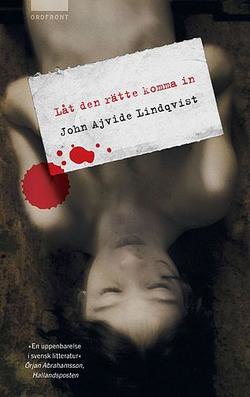
15. A book you’ve seen adapted: Let the Right One In by John Ajvide Lindqvist
List Progress: 6/30
The 2008 Swedish horror film Let the Right One In is a touching story about the developing friendship and love between an outcast human boy and a girl who has lived as a child vampire for two hundred years, and it is very good. But it is based off of the 2004 novel of the same name by John Ajvide Lindqvist. And while their plots are almost entirely the same, the novel Let the Right One In manages to be about an entire community torn asunder by violence and desperation and love in the face of alienation. The movie picks Oskar and Eli’s story out of the book and highlights it, but misses a lot of the greater scope and depth that make the original novel great. And each later adaptation, like the 2010 American film remake or the recent stage adaptation, narrows the scope just a little more.
Let the Right One In (Låt den rätte komma in in the original Swedish, but titled after the English song “Let the Right One Slip In” by Morrissey), follows a bullied boy named Oskar in 1980’s Sweden who meets a strange girl named Eli when she moves in next door. He is drawn to her mysterious and odd ways and eventually comes to learn that she is a very old vampire, stuck in the body of a child, and that her “father” is nothing more than her thrall who has committed a recent string of murders to supply her with blood. Oskar has to decide whether his new friendship and love for Eli is worth descending into a world of darkness and violence.
But that violence is never kept abstract. One of Eli’s first victims is a man named Jocke, a regular schlub who likes to hang out and drink with his friends in a dingy Chinese restaurant, and who would be a footnote in most stories. But Jocke was a person, with his own likes and dislikes, passions and relationships, and his disappearance impacts those who love him. The Chinese Restaurant Crew gets a subplot in the film adaptation, and are ultimately cut from the stage play, but the grief of Jocke’s best friend Lacke makes up a lot of the heart of the novel. While Oskar is feeling connection and companionship for the first time with Eli, her very existence demands taking that away from other people and it constantly asks the reader if it could possibly be worth it. Lindqvist has a real gift for quick characterization, from major players like Lacke, to bit figures who come and go. At one point, Eli needs to slip into a hospital, and the narrative takes the time to put the reader in the head of the night shift nurse manning the desk, bored and making up little stories to herself about the people coming and going. From a purely utilitarian view, there’s no point to this: the woman provides no major obstacle to Eli and will never return after this scene. But she is a person whose life is being impacted by Eli’s unnatural existence and she deserves her time in the sun, however brief. And sometimes the detours into bit characters are much-needed bits of comic relief, like an aside about a police officer having to restrain a goat during an investigation and having the photograph go viral. Making every character a person makes their joys so much more joyful, and the horrors far, far more horrible.
The novel is not for the faint of heart, as violence and sexual abuse are portrayed with a deft hand that manages to be visceral without tripping over into gratuitous. (Though one’s mileage may vary on this point; as one example, Eli’s manservant Hakan only follows her because he is a pedophile and he would do anything for this eternal child to want him as he wants her. There may be many readers who would find that reason enough to close the book.) But for a reader who wants to engage, this is a beautiful, breathtaking story that really needs the length of a novel to really make it shine.
Would I Recommend It: Absolutely. I really like the movie and have for years, but I loved the novel.
 Alanna McFall