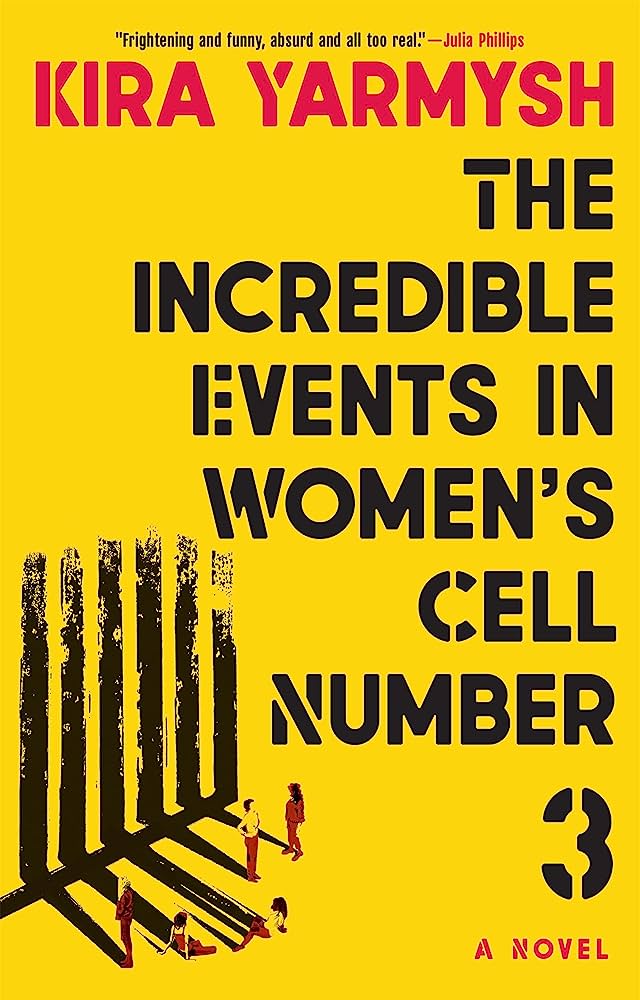
9. A book written in Russia: The Incredible Events in Women’s Cell Number 3 by Kira Yarmysh
List Progress: 12/30
When we as a society hold someone captive in a prison, jail or detention center, what are we trying to achieve? The main character of Kira Yarmysh’s The Incredible Events in Women’s Cell Number 3 is sentenced to ten days in a detention center in Moscow after she participated in an anti-corruption rally. Is society safer without her in public life for ten days? No, because she was never violent. Will she learn a lesson from her time in prison? No, because she was protesting corruption in the first place, and exposure to the prison system certainly won’t change her mind. Will anyone’s lives be better because of her ten day imprisonment? No, and yet carceral systems all over the world are based around holding people for various lengths of time for no real purpose. The Incredible Events in Women’s Cell Number 3 is at its strongest when it is investigating this system and the assumptions built into it. Unfortunately, these messages get buried in a lot of lackluster character work and some underdeveloped attempts at magical realism, making the novel as a whole a bit of a jumble.
Kira Yarmysh is the press secretary and assistant of Russian opposition leader Alexei Navalny, and The Incredible Events is her first novel. While it is a piece of fiction, Yarmysh shares a lot of backstory with Anya, and has spent time in detention centers after protests and political actions. The novel shines when it is just about Anya navigating the absurdity of the detention center. She is held in the titular Cell Number 3, the only women’s cell in an otherwise male facility, with five other women from various walks of life, each serving similarly short sentences for petty crimes. The inmates serve as a cross-section of contemporary Russian culture, from an older woman who has spent time in an actual prison camp and considers the center a cake-walk, to a young sugar baby who wants to get back to her life of thinly-veiled sex work with rich men. They are all tossed in together, but no one is around long enough to develop a real prison culture, so it is just an odd break from the rest of their lives.
Unfortunately, Anya ends up being the least interesting of the inmates, and the novel spends long periods of time flashing back to formative parts of her life. It is notable that she is a queer woman in Russia, and she navigates some difficult situations throughout her life, but none that feel especially worthy of close study. She also starts seeing visions while in the detention center, the supposed incredible events, and it is unclear whether there are supernatural elements at play or if some latent mental illness is coming to the surface in the face of the stress of incarceration. But the book keeps with this ambiguity far too late into the run, making the final conclusion feel very abrupt and tacked on. Moving some of the revelations earlier and cutting some of Anya’s story would make for a tighter, more powerful book, rather than the slightly bloated final product.
Yarmysh has a good sense for atmosphere and dialogue, which will hopefully be honed in later works, but The Incredible Events in Women’s Cell Number 3 still needs a fair amount of tweaking in the plot and character departments. But the parts that are powerful still work, which all adds up to a bit of a shrug.
Would I Recommend It: Soft yes.
 Alanna McFall